 Where design professionals shop
PLEASE GET IN TOUCH ON:
01584 877276
Where design professionals shop


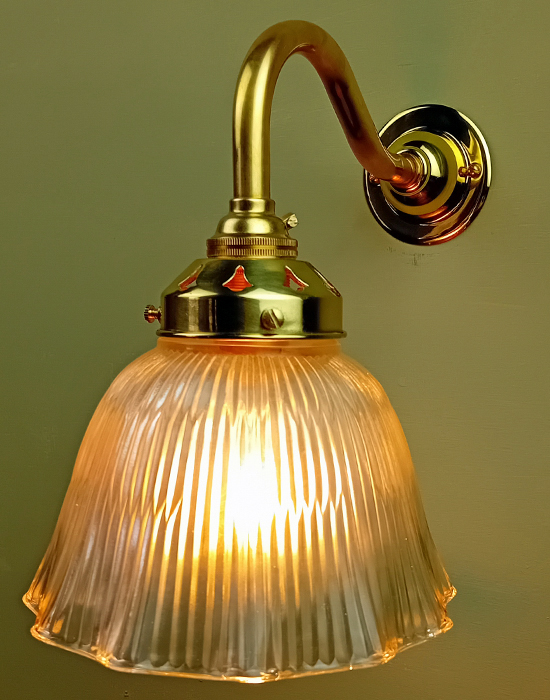


A classic design inspired from the 1880s, this fixture is based on a model originally supplied by Simplex and thoughtfully assembled using British and European-made components. The frame is crafted from solid brass, available in a selection of finishes including polished, acid-dipped antiqued, or nickel-plated. The frilly prismatic glass shade introduces a distinct decorative flair, casting a soft, even light that elevates the ambiance of any room. As with all our products, each part is fully recyclable, reflecting our commitment to creating sustainable, environmentally conscious designs.
This style of wall light is reminiscent of early gas lighting and transitioned into electric wall lights by the 20th century. Its timeless and versatile appeal makes it just as fitting today—whether in its original application or adapted as an uplighter. As with many of our fixtures, the components are manufactured in Birmingham or Northern Ireland.
We recommend the use of modern LED bulbs and, if used, there is no restriction on its power. If old, filament (incandescent) bulbs are used then a maximum of 40w is recommended.
Prismatic Shades - 'Holophane'
During the early 1890s Andre Blondel, a French engineer and physicist, known for his work in electrical research and an attache to the Lighthouses and Beacons Service, and Spiridion Psaroudaki, a Greek engineer, conceived an idea in a Paris laboratory to cover a glass globe with horizontal glass prisms properly positioned to control light. Patents were awarded to the two inventors in Europe and, upon the granting of US Patent 563836 in 1893, an American, Otis A. Mygatt was introduced to this work. He saw the potential for both domestic and industrial lighting and began to collaborate with Blondel and Psaroudaki.
The advantages of prismatic shades very quickly became clear to a European public demanding brighter light. The prisms effectively focused the dim bulbs output to produce clear, bright, clean illumination and proved very popular in shops, schools, factories, lighthouses and homes. So much so that Mygatt bought the worldwide rights to Blondel and Psaroudaki's invention in 1894 and formed the Holophane Glass Company in 1898 in London to capitalise on his purchase. That same year Mygatt transferred the company to No.1 Broadway, New York.
The term 'Holophane' was derived from the Greek - 'Holos' and 'Phanein' - to contrive the meaning 'to appear completely luminous'. In 1900 Holophane was manufacturing a large range of globes and reflectors and described them thus: [they are made of] 'perfectly clear glass with prisms scientifically constructed in such a manner as to both direct the rays of light in downward and outward directions'.
Height: 23cm
Width: 16cm
Projection: 26cm
